- ICIRR (for immigration-related arrests and ICE sightings): 855-435-7693
- NLG Hotline (if you are arrested at a protest or for political activity): 872-465-4244
- Cook County Public Defender hotline (if you are arrested in Chicago or any other city or town in Cook County): 844-817-4448
- First Defense Legal Aid Hotline (to report police, federal law enforcement, or national guard misconduct): 800-529-7374
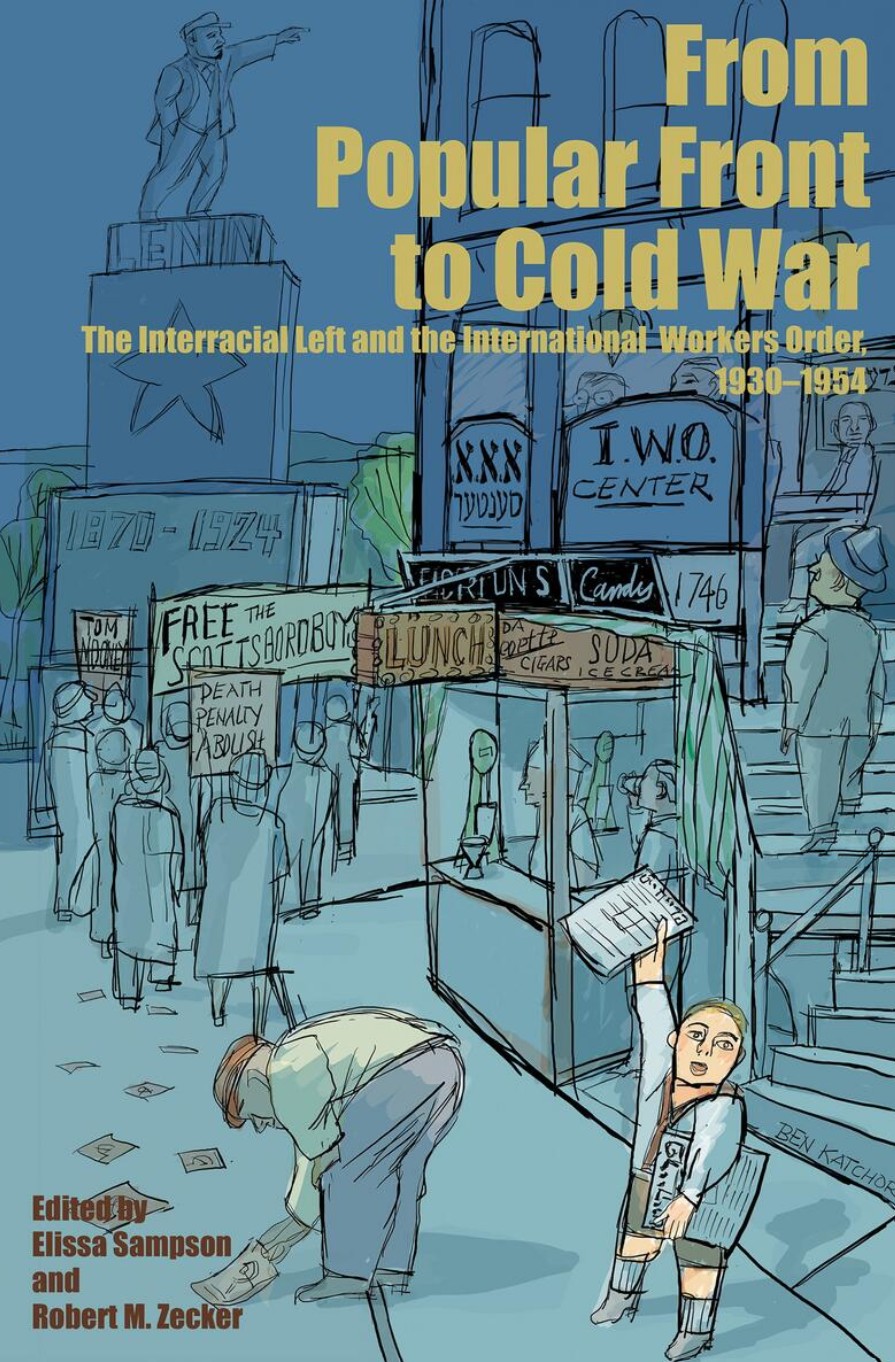
From Popular Front to Cold War: The Interracial Left and the International Workers Order, 1930–1954
Posted by Andy1917
Content: Join us as we welcome Elissa Sampson, Bob Zecker, Felicia Bevel, and Matt Calihman to the store for a discussion of From Popular Front to Cold War: The Interracial Left and the International Workers Order, 1930–1954. From Popular Front to Cold War tells the story of the International Workers Order (IWO), an organization founded in 1930 to provide life, burial, and health insurance to its members. But as the essays gathered by Elissa Sampson and Robert M. Zecker make clear, the IWO broadened its mission to promote interracial solidarity, support labor unions, combat racism and antisemitism, and champion progressive social programs from the Great Depression into the postwar era. At its height, the IWO had almost two hundred thousand members drawn from a broad ethnic and racial spectrum of the working class—Jews, Blacks, Poles, Slovaks, Italians, Hispanics, and others. It operated summer camps, published foreign-language newspapers, and supported a wide range of cultural activities. An early advocate for the United States' entry into World War II, the IWO was also ahead of its time in championing the nascent civil rights movement. After the war, it was declared a subversive organization due to its ties to the Communist Party and disbanded in 1954, though its legacy as a model for working-class cooperation across racial and ethnic differences endures to this day. Felicia Bevel is an Assistant Professor of History at the University of North Florida. Her research and teaching interests include African American history, twentieth century U.S. history, cultural history, southern studies, and childhood studies. Her current research examines early twentieth century American cultural productions that romanticized the Old South and circulated outside the U.S. within the larger Pacific world, specifically in Canada and Australia. In addition to her chapter in From Popular Front to Cold War, her work has recently appeared in the Mississippi Quarterly and the Journal of Transnational American Studies. At UNF, she teaches courses such as the Civil Rights Movement, the Black Pacific, and Blackness in Archives. She is also a faculty team member on the Red Hill Cemetery Project, a collaboration between UNF, the Okefenokee Heritage Center, and the Black Heritage Committee to restore and document the history of a historically African American cemetery in Waycross, GA. Matt Calihman is professor of English at Missouri State University, where he teaches African American literature and other U.S. literature courses. He has published articles and book chapters on Amiri Baraka, Ralph Ellison, Langston Hughes, and John A. Williams, focusing on their relationships to the radical left. The Cambridge Companion to American Poetry and Politics since 1900 (ed. Daniel Morris; 2023) included Matt’s essay on “African American Political Poetries.” He is the co-editor, with Gerald Early, of Approaches to Teaching Baraka’s Dutchman (MLA; 2018) and the co-editor, with Tracy Floreani and A Yęmisi Jimoh, of the Ralph Ellison Special Issue of American Studies (2015). Dr. Elissa Sampson is an urban geographer who studies how the past is actively used to create new spaces of migration, memory, heritage, and activism. She has pursued a life-long interest in migration, diaspora, re-diasporization, and immigrant culture on New York’s Lower East Side, Brooklyn and Paris, making visible dynamic interactions among diasporas in shared spaces/places. As a Lecturer in Cornell University’s Jewish Studies Program, Dr. Sampson has taught labor and gender history, including the 1911 Triangle Shirtwaist Fire, its memorialization, and relationship to current labor activism. Now a Research Associate, Dr. Sampson has worked extensively with Cornell’s Kheel Center confiscated Cold War archives on the International Workers Order (IWO), including their partial digitization. She co-organized a public, online academic conference, “Di Linke” (the Left), based largely on its archival Jewish Section holdings. She is the co-editor and contributor to From Popular Front to Cold War: The Interracial Left and the International Workers Order, 1930–1954. She is currently researching the early microfilm files that detail the work of the International Labor Defense (ILD), ―the Civil Rights Congress’ (CRC) predecessor―, whose heads worked primarily in New York and Chicago. Robert M. Zecker is a professor of history at Saint Francis Xavier University, Nova Scotia, Canada, where he teaches courses in race, immigration, social movements, and U.S. history. His research includes immigration, radicalism and the popular culture of immigrants on the left. He is the author of five books, including “A Road to Peace and Freedom”: The International Workers Order and the Struggle for Economic Justice and Civil Rights, 1930-1954 (Temple University Press.) He has also contributed book chapters to eight edited volumes, most recently the chapter, “Spotlight on Jim Crow”: Radical Immigrant Papers Cover Race and Civil Rights,” in Immigration and Exile: The Foreign-Language Press in the U.K. and U.S., recently published by Bloomsbury. He has published numerous articles in journals such as the Journal of American Ethnic History, the Journal of the Canadian Historical Association, Oral History Review, Ethnic Forum, American Studies, the Journal of Social History, the Journal of Popular Culture, and American Communist History. Dr. Zecker has presented his research at conferences in Canada, the United States, the United Kingdom, Holland, France, Italy, the United Arab Emirates, Pakistan, Finland, Turkey, and Ireland. His current research includes a book manuscript on Communist Party workers’ schools, "Training for the Class Struggle," appearing soon (Inshallah!) from Routledge. Before entering the academic racket, Bob was an ink-stained wretch foisting journalism on an unsuspecting public in his native New Jersey.
Date/Time: Oct. 24, 2026, 6 p.m. - Oct. 24, 2026, 7 p.m.
Location: Pilsen Community Books, 1531 W. 18th St, Chicago
Sponsoring Organization:
Link(s):
Share: